
During a short trip to Texas in May I managed to do some birding which was very rewarding. I picked up about a half dozen lifers (birding term for birds seen for the first time) in the neighborhood where I was staying, including a black-chinned hummingbird. Twice I glimpsed a long-tailed bird darting into the bushes along the road that I suspected might be a road runner, but did not get a good enough look to be sure. A visit to Waco wetlands yielded another dozen birds that were new to me.
While I was birding but not photographing during that trip, this has prompted me to revisit some of my favorite and most popular avian images.
Note that clicking on any of the images in the newsletter below will take you to the Wild Florida Photo website page for that subject.
January 2013 I was on the observation tower overlooking Paynes Prairie when I noticed a small group of large white birds in the distance flying across the prairie. Thinking that they might have been whooping cranes, I excitedly snapped a photo. On later inspection of the image I decided that they were likely wood storks.
 Paynes Prairie White Birds
What I liked most about this image is the painterly effect from the bands of different colored vegetation spread across the prairie.
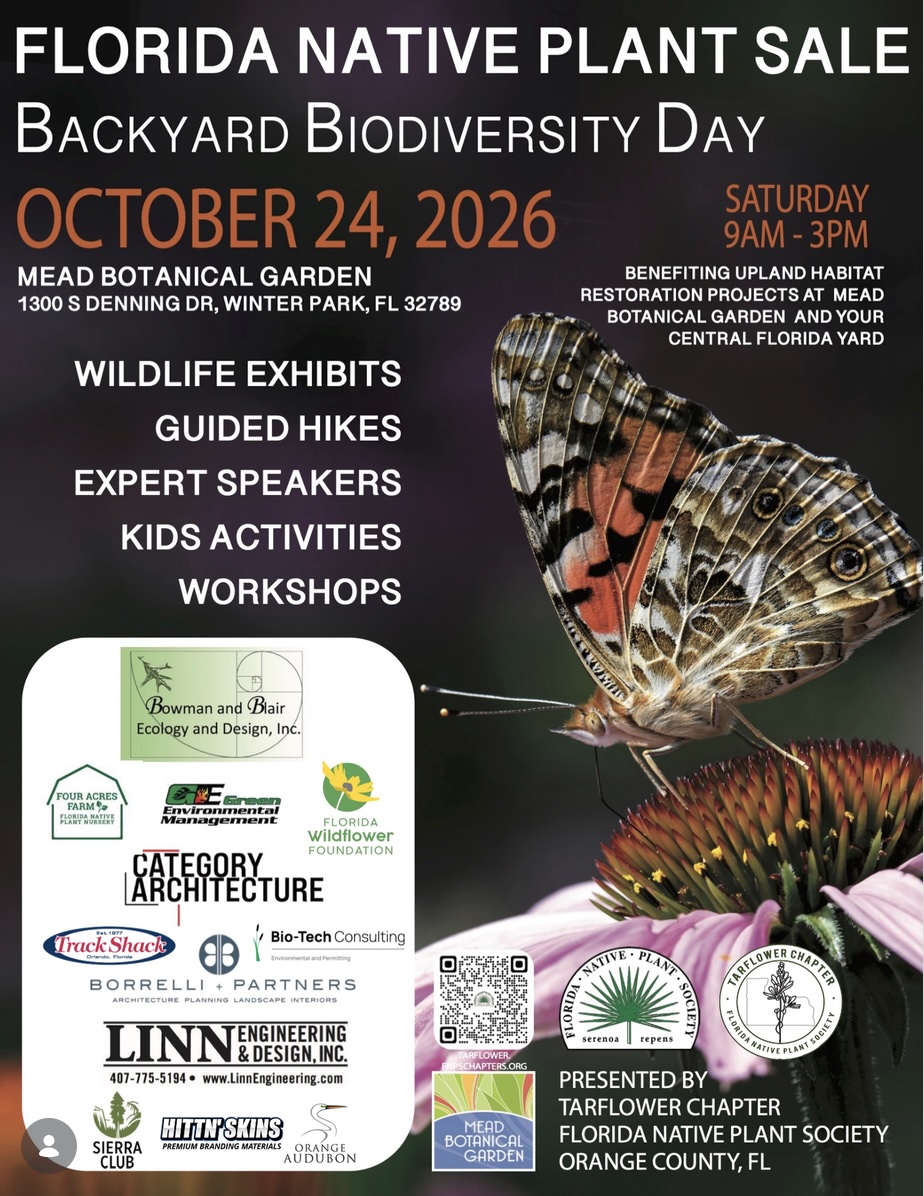
Paul Rebmann Nature Photography/Wild Florida Photo will be at Backyard Biodiversity Day Saturday, Oct. 24 from 9am to 3pm at Winter Park's Mead Gardens.
Backyard Biodiversity Day is an annual event hosted by the Tarflower Chapter of the Florida Native Plant Society that includes an extensive native plant sale, informative
speakers, guided walks and many information and vendor booths.
For details on this and other events, visit the Wild Florida Photo events page.
At the St. Augustine Alligator Farm in 2008 I was photographing the many breeding birds in the rookery when a single roseate spoonbill flew directly overhead, allowing me to capture this image of Roseate Soaring.
 Roseate Soaring
Note that the Alligator Farm offers an annual Photo membership that allows early entry on select dates that includes the breeding season.
An early 2012 winter morning after a cold front moved through created a rising mist above the warmer water of the ocean. While photographing this effect, a lone pelican flew past as shown in this image.
 Pelican in Sea Smoke
Most pelicans in Florida are brown pelicans like the one above, although white pelicans can be seen in the Sunshine State during the winter. While brown pelicans mostly feed by diving into the water, white pelicans do not dive, instead feeding while swimming on the surface.
During a visit to Lyonia Preserve in 2010, a portion of the preserve had recently been roller-chopped to improve the habitat for the Florida scrub jays that live there. Roller chopping is often done to cut down the shubs and small trees when they get too thick and/or tall to be appropriate scrub jay habitat and burning is not an option, which is the case at this preserve that is situated in the middle of the town of Deltona, FL.
While walking a trail that passed between the scrub habitat and the recently chopped area, scrub jays were darting out of the scrub into the clearing looking for acorns. One of these jays posed for a photograph atop a small mound of chop.
 Scrub Jay on Chop #2
Florida scrub jays are Florida's only endemic bird, meaning they are naturally found nowhere else but Florida. This image was part of my "Only in Florida" exhibit at the Lyonia Gallery in 2016. There are several other species of scrub jays, all of which live in limited areas of the western United States, Mexico and Central America.
One September afternoon in 2007 while exploring a lesser-visited section of Tomoka State park I came across this Anhinga in a tall pine tree.
 Anhinga Pine
During the same day in which there were rain showers in the area I captured one of my rainbow images.
After a 2015 Florida Native Plant Society Pawpaw Chapter field trip in the Ocala National Forest lead by Susan Carr, I stayed and wandered around Clearwater Lake to find a sandhill crane feeding along the shoreline.
 Sandhill Crane at Clearwater Lake
There are two separate populations of sandhill cranes in Florida. Between four and five thousand cranes remain year-round in the Sunshine State. Around 30,000 migrating sandhill cranes spend winters in Florida and summers in the midwest and Canada, many around the Great Lakes.
Thank you, and I hope that you enjoy my photography.
Paul Rebmann
Wild Florida Photo
paul-rebmann.pixels.com
iNaturalist: NaturePaul
This newsletter will normally be sent out no more than once a month.
You have received this newsletter because you signed up at an event, on one of Paul Rebmann's websites or you entered in one of the drawings for a print giveaway.
To Unsubscribe: you may always opt-out by simply replying to this message and asking to be removed.
If this newsletter was forwarded to you by someone, you may sign up at Subscribe or send an e-mail to newsletter@wildflphoto.com requesting to be added to the list.
©Wild Florida Photo